Does Anti-Blue-Light Really Help Your Eyes? What It Can and Can't Do
Last updated: October 2026
Quick answer: An anti-blue-light screen guard reduces some of the blue light coming from your screen, but good research has not shown that this alone prevents eye strain. A 2023 Cochrane review concluded that blue-light-filtering lenses gave little or no short-term benefit for eye strain. What does help is cutting glare, setting a comfortable brightness, taking regular breaks and seeing an eye doctor if discomfort continues.
We make anti-blue-light screen guards, so you might expect us to tell you they fix tired eyes. We would rather give you the straight answer. People ask "does anti blue light screen guard work" because the claims online are confusing, and the honest reply is: it depends on what you expect it to do.
What is blue light, and why do people worry about it?
Blue light is the short-wavelength, high-energy part of visible light. The sun is by far the largest source of it. Laptop, phone and monitor screens give off blue light too, at much lower levels than daylight.
The worry usually comes from two places. The first is eye discomfort after long screen sessions: dryness, burning, blurred vision or headaches, often grouped together as digital eye strain. The second is sleep, since bright light in the evening, and blue light in particular, can affect the body's sleep signals.
In a 2025 WhatsApp survey of 224 Pxin customers, with a follow-up of 171 (a customer survey, not a national sample), 90% said they believe blue light harms the eyes, but just 24% had asked a doctor about it. Many people are worried, but few have had their eyes checked. You can read the full privacy screen and eye strain research report for the details.
Does anti blue light screen guard work? What the research says
The most careful summary of the evidence so far is the 2023 Cochrane review. It compared blue-light-filtering spectacle lenses with ordinary lenses and reported little or no short-term difference in eye strain. Screen guards and glasses work on the same principle, filtering part of the blue light before it reaches your eyes, so there is no strong reason to expect a different result for a screen film.
Our own survey points the same way. Among the customers who answered, frequent eye strain was reported by 40% of people who use night mode and 43% of those who do not. That is no meaningful difference. Shifting screen colour warmer did not, on its own, appear to change how strained people's eyes felt.
So if your main goal is "no more tired eyes", a blue light filter by itself is unlikely to get you there.
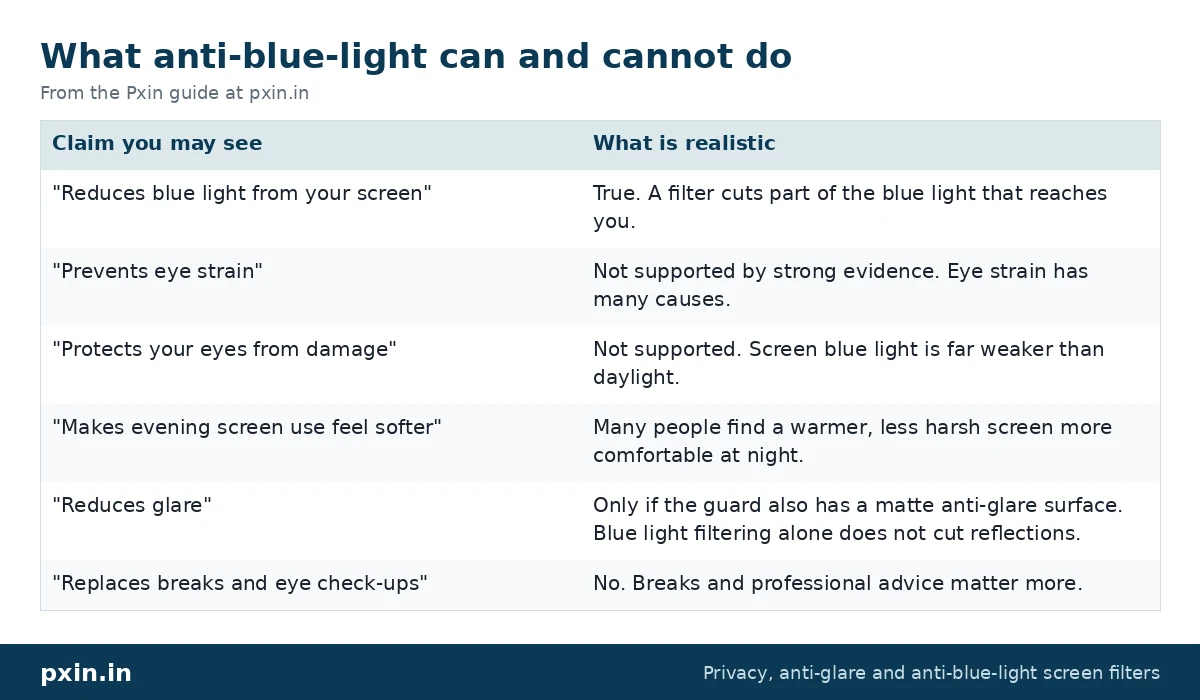
What anti-blue-light can and cannot do
| Claim you may see | What is realistic |
|---|---|
| "Reduces blue light from your screen" | True. A filter cuts part of the blue light that reaches you. |
| "Prevents eye strain" | Not supported by strong evidence. Eye strain has many causes. |
| "Protects your eyes from damage" | Not supported. Screen blue light is far weaker than daylight. |
| "Makes evening screen use feel softer" | Many people find a warmer, less harsh screen more comfortable at night. |
| "Reduces glare" | Only if the guard also has a matte anti-glare surface. Blue light filtering alone does not cut reflections. |
| "Replaces breaks and eye check-ups" | No. Breaks and professional advice matter more. |
Why your eyes really get tired at the screen
Digital eye strain usually comes from a mix of everyday factors:
- Blinking less. Focused screen work cuts your blink rate, and the front of the eye dries out faster.
- Glare and reflections. Windows, tube lights and overhead lamps bounce off glossy screens and make you squint.
- Wrong brightness. A screen much brighter or much dimmer than the room makes your eyes work harder.
- Distance and posture. Sitting too close, or looking up at a monitor, adds effort.
- Uncorrected vision. An old or missing prescription is a common hidden cause.
- Long unbroken sessions. Hours of close focus without a pause tire the focusing muscles.
Notice that blue light is not on this list as a main cause. Glare is, and it is very common. Our customer survey reflects this: 59% said they face frequent screen glare, and 42% said their eyes feel strained often or very often.
Where an anti-blue-light screen guard can still help
Most of our guards combine anti-blue-light with a matte anti-glare surface. Anti-glare is a matte film that diffuses reflections, so a window or ceiling light behind you turns into a gentle blur rather than a harsh white spot. If glare is part of what bothers you, that matte layer does real, visible work.
The blue light part is more about comfort and preference. Some people simply like a slightly warmer, softer look during late work. That is a fair reason to choose it, as long as you know it is not a medical treatment.
If you are comparing types, our laptop anti-glare and anti-blue-light screen guards and monitor anti-glare screen guards cover most common sizes. For tablets, see the iPad anti-glare screen guard range. And if you are unsure whether you need glare control or privacy, read our post on privacy screen vs anti-glare.
The limitation you should know about
A matte anti-glare surface scatters light slightly, so very fine text can look a little softer and you may notice a faint grain on white backgrounds, especially on high-resolution displays. Most people stop noticing it after a few days, but if you do colour-critical photo or design work, a matte film is a trade-off worth thinking about.
Blue light filter vs Night Shift and Night Light
Your devices already have a free software option. Night Shift on Apple devices and Night Light on Windows shift the screen towards warmer colours in the evening. They do a similar job to a blue light film for colour warmth, and you can schedule them or turn them off for colour work.
What software cannot do is remove reflections from a glossy screen. That is the main reason people pick a physical matte guard. If your screen is already matte and glare is not a problem, Night Shift or Night Light may be all you need for evening comfort. Our post on iMac 24 inch anti-glare screen guards looks at this choice for a glossy desktop display.
Habits that help your eyes more than any filter
- Use the 20-20-20 rule. After each 20 minutes of screen time, rest your focus on something around 20 feet away for 20 seconds.
- Match brightness to the room. The screen should not look like a light source in a dim room, or look washed out in a bright one.
- Move the screen, not your eyes. Place it about an arm's length away, with the top roughly at eye level.
- Control light sources. Keep bright windows to your side, not directly behind or in front of the screen.
- Blink on purpose. A few full blinks during long tasks help keep the eye surface moist.
- Get your eyes checked. If strain, headaches or blurred vision continue, see an eye doctor. A screen guard is not a substitute.
- Wind down at night. Lower brightness and warm the colours in the last hour before bed.
Watch: India's Best Laptop Privacy Screen? Anti-Blue + Anti-Glare | Pxin.in Review & Demo
https://www.youtube.com/watch?v=ARd_NKW5RpE
Developer: paste this YouTube link on its own line in WordPress so it shows as an embedded video. Video by WhySoTechie.
Frequently asked questions
Does an anti blue light screen guard really work?
It does reduce some blue light from your screen. However, the evidence does not show that this alone reduces eye strain, and in 2023 the Cochrane reviewers saw little or no short-term gain from blue-light-filtering lenses.
Is anti blue light or anti glare better for eye strain?
For most people, glare control makes the bigger visible difference, because reflections make you squint and refocus. Many guards combine both, so you do not always have to choose.
Is blue light from a laptop harmful to your eyes?
Screens give off far less blue light than daylight, and there is no strong evidence that normal screen use damages the eyes. Discomfort usually comes from long sessions, glare and less blinking.
Is Night Shift the same as a blue light screen protector?
They do a similar job for colour warmth. Night Shift or Night Light is free and adjustable, while a physical guard can also add a matte anti-glare surface that software cannot.
Should I still use an anti-blue-light screen guard?
If you like a softer, warmer screen at night or need glare control, it can be a sensible comfort choice. Just pair it with breaks, good lighting and regular eye check-ups.
Find the right filter
If reflections and late-night harshness are what bother you, start with our laptop anti-glare and anti-blue-light screen guards, and match the size and aspect ratio to your screen. If eye discomfort continues after that, an eye check-up is the next step.